Whenever I tell someone I have handed most of my company's operations to AI, the first question is never about the work. It is about the bill. How much does that cost you a month?
Fair question. It was my first question too. Before I started, I searched for pricing pages like everyone else, tried to guess what a real workload would consume, and got nowhere. So here are my actual numbers, with nothing rounded in my favor.
The real bill
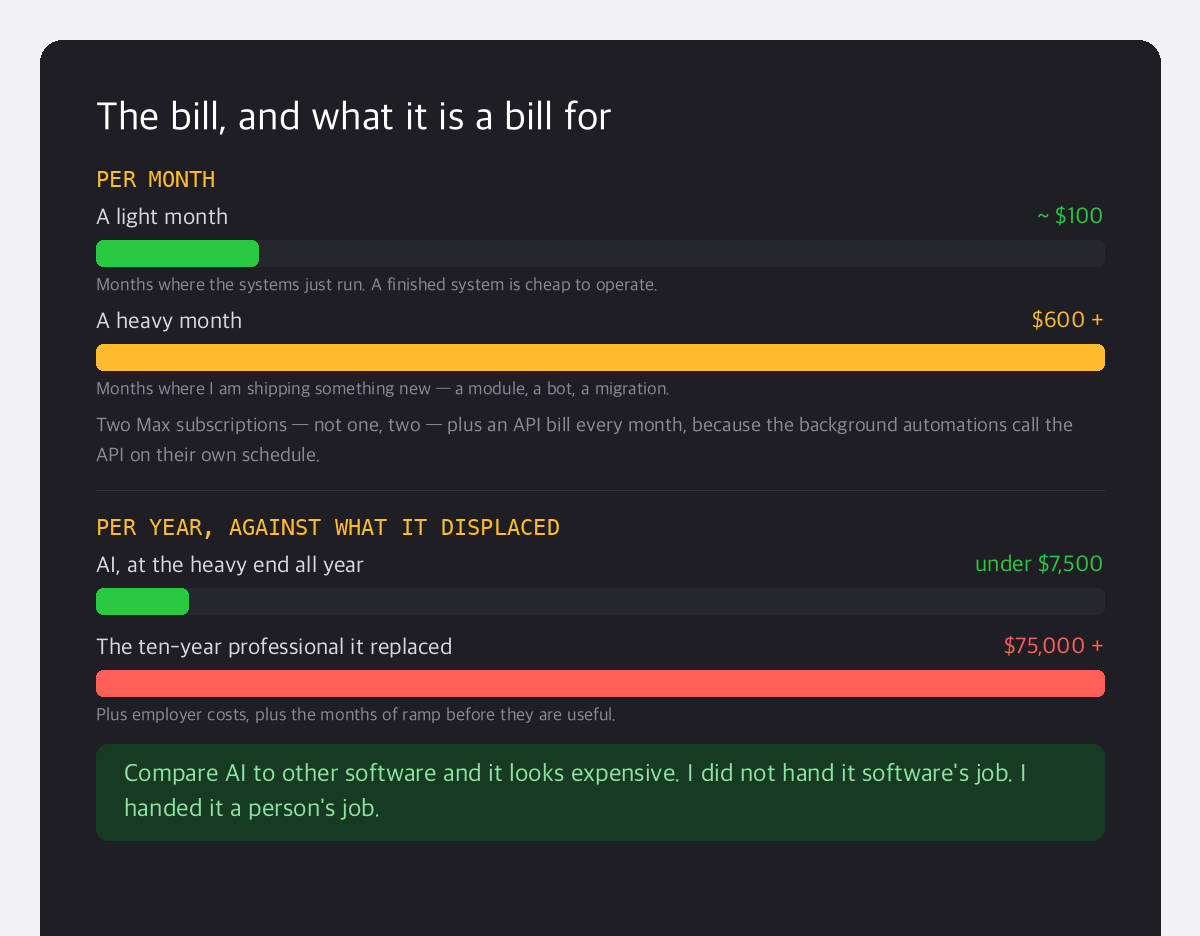
I run two Max accounts. Not one. Two. And even with two, there are plenty of days where I hit the weekly usage limit and sit there waiting for it to reset. On top of the subscriptions there is an API bill every month, because the automations that run in the background do not use my chat session; they call the API on their own schedule.
Add it all together and a light month lands around a hundred dollars. A heavy month goes past six hundred.
That is the honest range. It moves with how much I am building. Months where I am shipping something new (a new module in our ERP, a new bot, a migration) sit at the top of that band. Months where the systems just run sit near the bottom, because a system that is finished is cheap to operate.
"Isn't that expensive?"
Looked at as a number, yes. If you are used to software that costs twenty or thirty dollars a month, six hundred is a lot. I will admit my hand shook a little the first time I authorized it.
But I think the sticker shock comes from an anchoring error, and it is worth naming.
The comparison is wrong
Compare AI to other software and it looks expensive. The problem is that I did not hand it software's job. I handed it a person's job.
Think about what would actually be required to replace what runs in my companies now. Not an intern. Someone who can read a bank statement, reconcile it against the ledger, understand why an entry is misclassified, draft the follow-up to the accountant, and not need me to explain the business twice. That is a ten-year professional. In my market, that person costs well north of seventy-five thousand dollars a year, plus employer costs, plus the months of ramp before they are useful.
Against that, six hundred a month is under seven and a half thousand a year. Less than what a part-time assistant costs.
And the comparison keeps going in directions people forget:
- It is easier to teach than a person. I explain a rule once and write it down, and the written version is the training.
- I can ask it anything, including the things I would feel stupid asking a hire I am supposed to be managing.
- It does not take vacation, and it does not quit in the middle of a close.
- It does not walk out with the company's information in its head.
None of that makes it a person. It is not. It has no judgment about what matters and it will confidently do the wrong thing if I describe the job badly. But when I price it, I have to price it against what it displaced, and what it displaced was not a spreadsheet plugin.
Which tier, practically
The tiers sort out about how you would expect. The free tier is for finding out whether you like working this way. Pro is the right home for individual real use: daily work, drafting, analysis. Max is for people like me who are handing over whole workflows and building tooling on top. If you attach automations, the API bill accrues separately, on top, metered by what you actually use.
My advice for anyone deciding: start on Pro. Do not pre-buy capacity for a workload you have not built yet. When you start hitting limits regularly, that is your signal to move up. The limit is the market telling you that you have real usage. That is exactly the path I took.
The formula I would use
Everyone's answer is different, so rather than telling you what to buy, here is the arithmetic I would run.
First, list your work honestly and specifically. Not "management": the actual repeating tasks, the ones you did yesterday and will do again on Thursday.
Second, put two prices next to that list. What would it cost to hire someone to do it? And what does it cost you to do it yourself, measured in your own hours at whatever you believe your hour is worth?
Then set those next to the subscription price.
If your time is cheaper than the tool, do not buy the tool. That is a real answer, and for some people it is the correct one. If your time is more expensive than the tool (and for most operators running a company it is not close), then there is nothing left to think about.
What I find is that most people never run the comparison at all. They compare the price to other software prices, decide it is expensive, and stop. The question was never whether it is expensive. The question is what it is expensive relative to.