For years my day had a shape, and the shape was email.
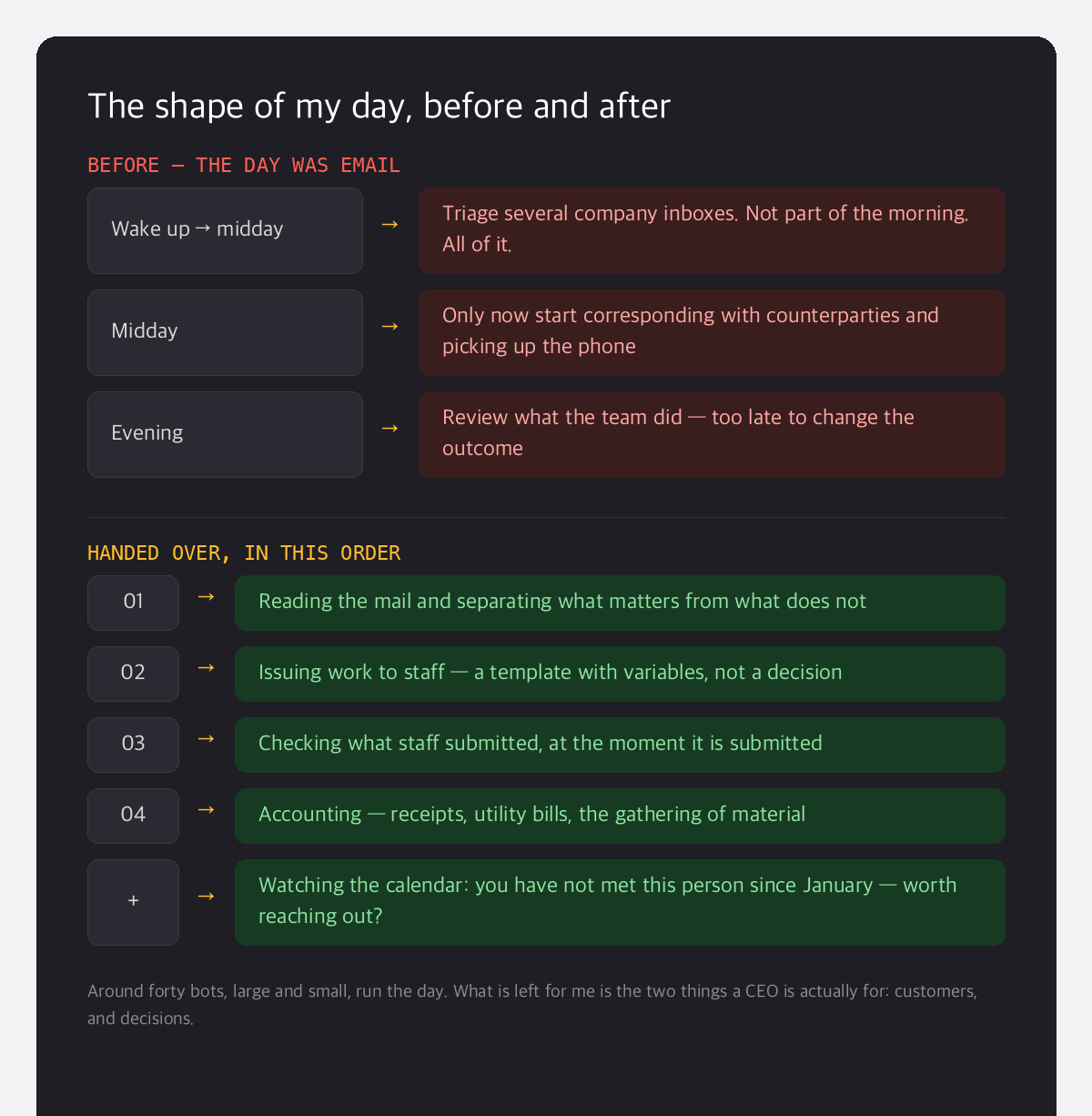
I would wake up and the first thing I did (before coffee, before anything) was triage the inbox. Several company accounts, so several inboxes. Read each message, decide whether it was urgent or noise, file it, flag it. That was the entire morning. Not part of the morning. All of it.
By the time I surfaced it was lunch. Only then did I start actually corresponding with counterparties, or picking up the phone. And reviewing what my staff had done (the thing a CEO is supposed to do while there is still time to change the outcome) happened in the evening, when it was too late to change anything.
Every day looked like that. For a long time I thought that was just what running multiple companies felt like.
I was doing work the system should have been doing
The realization, when it came, was uncomfortable. I looked at my calendar honestly and saw that I was not spending my time on sales, or on decisions, or on the handful of things only I can do. I was spending it on sorting, routing, and checking. Those are not executive tasks. Those are system tasks, and I had made myself the system.
So I started looking into office automation. And here is the first thing I got wrong: when people hear "office automation" they picture some grand transformation of the whole company: new platform, new process, everything different on Monday. That is not how it goes when you actually do it.
What actually happens is much smaller and much more personal. You go looking for the things you repeat every single day. That is the entire search. And in my case, the answer was sitting right there in the morning routine I just described.
The four things I automated first
I started with four, in this order:
One: reading the mail and separating what matters from what doesn't. The oldest habit, the biggest block of time, the least judgment required. Obvious first candidate.
Two: issuing work to staff. The instructions I gave were repetitive in structure even when the content changed. That is a template with variables, not a decision.
Three: checking what staff had done, immediately. Not at 9pm. At the moment it was submitted, against the thing I asked for.
Four: accounting. Receipts, utility bills, the whole business of gathering material into a state where an accountant can use it, work I had been doing with my own hands.
None of this took as long to build as I expected. And I know exactly why: I had been doing all four by hand, every day, for years. When you have done a job personally a thousand times, you already know precisely what to specify. There is no discovery phase. The hard part of automation is usually understanding the work, and I had already paid that cost the slow way.
I kept handing things over, one at a time. Today there are around forty bots, large and small, running the company's day.
What surprised me was what I found underneath
I expected to feel relief. What I actually felt, once the time opened up, was mild embarrassment.
Because with the mornings free, I could finally see how badly I had been neglecting sales. How little time I had been giving customers. It had not felt like neglect while it was happening. I was busy from dawn to dark, and busyness is very good at disguising itself as diligence. The inbox had been eating the exact hours that should have gone to the people who pay us.
So lately I have pushed further, and I let AI help with the customer side too. It watches the calendar and tells me things like: you have not met this person since January. Worth reaching out? Relationships I would simply have let drift now surface on their own. Nothing about that is clever technology. It is a query against a calendar. But it catches what I was reliably missing.
The real return was not hours
I have been running the company this way since the spring, and the biggest thing I got out of it was not saved time.
It was that to automate a task, you have to decompose it and explain it. Out loud, in order, with the edge cases. You cannot hand over a job you cannot describe. And I found that after describing my own work carefully enough to delegate it to a machine, I understood the business far better than I had while doing it by hand for a decade.
That is the part nobody sells you. Automation is a forcing function for clarity. The bots are a side effect.
And once I understood the work, I started spending my time on the two things a CEO is actually for: customers, and decisions.
Next time, the question everyone asks me at this point in the conversation: what does it cost per month to run a company this way. I will publish the real number.