I started a trading company in 2013. Today I run several businesses. And I cannot write a single line of code.
I want to lead with that because of what follows. This is not a tool review and it is not a tutorial. There are plenty of good guides on installation and setup, and I am not going to duplicate them. This is how I personally work, four months in.
What it is, in operator's terms
Claude Code is an AI that can do work on my own machine, without the usual walls. I talk to it in a chat window and it creates files, writes programs, organizes material. That is the mechanical description.
The purpose, for me, is narrower than that: automate as much of the work I already do as possible, so that I can concentrate on the work only I can do.
Here is the concrete result. We used to run a commercial ERP package. Now we run an ERP I built: quotes, sales, inventory, accounting, all of it. No developer. Built by a CEO who cannot code.
I am not saying that to impress anyone. I am saying it because if you have ever sat in a vendor demo thinking this is 70% of what we need and I will spend two years fighting the other 30%, the situation has changed, and I do not think most operators have noticed yet.
The trap in the word "fully automatic"
There is a misconception I run into constantly. When people hear automation, they picture the AI running everything on its own while they sleep. That is not what I am describing.
My way works like this: I tell it what I need, and it organizes the input into our ERP's format and enters it. The AI is not deciding on its own initiative and acting. I give an instruction and it executes it my way. Semi-automatic.
I think this is both more convenient and considerably safer, and I chose it deliberately rather than as a stepping stone.
Safer is obvious enough. These systems touch our books, and a wrong entry made confidently at 3am is worse than no entry. But convenient is the part people miss. When I am in the loop, I get to change my mind. Half the value of the chat window is that I can say "no, not like that, do it this way instead," and the correction is instant. A fully autonomous pipeline gives that up in exchange for a promise it usually cannot keep.
Right now everyone is talking about agents, and everyone wants to start at total automation. My view is that the right starting point is to build a program with AI and then operate it by giving instructions in a chat window. Start there. Earn the rest.
There is an order to this
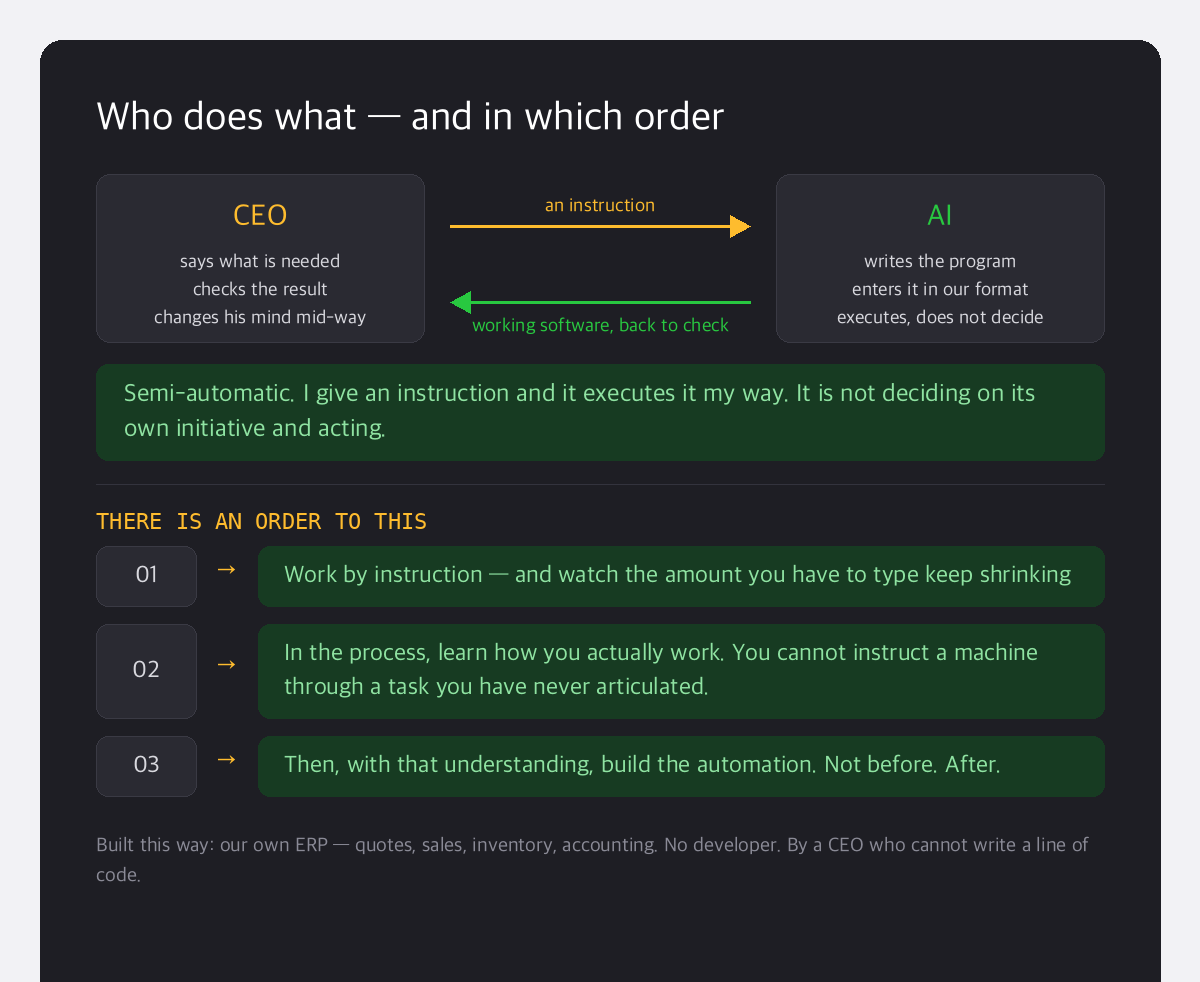
What is strange (and this is the part I most want to pass on) is what happens once you have been working by instruction for a while.
The amount you have to type keeps shrinking. You notice you are repeating the same phrasing, so you fix the phrasing into the tool. The instruction gets shorter every month.
In the process, you learn how you actually work. This is the real prize. You cannot instruct a machine through a task you have never articulated. Being forced to say it out loud, in order, exposes what your process really is, including the parts that turn out to be habit rather than logic.
Then, with that understanding, you build the automation. Not before. After.
A lot of people skip the first two steps because someone told them it can be fully automatic from day one. What happens then is predictable: you end up fitting your business into someone else's automation without ever having understood your own work. And you cannot tell whether the output is right, because you never knew what right looked like.
This is the same reason I do not think "buy the platform" is the shortcut it appears to be. The platform encodes someone else's process. If you have not written down your own, you will adopt theirs by default and call it best practice.
The goal was never full autonomy
Let me put the whole method in one sentence, because it is genuinely this small.
Build your own work as software while you are doing it, and keep shaving the product down over time.
That is all of it. Four months of this and the shape of my company is different, not because I found a clever tool, but because building the tool made me describe the business, and describing the business made the automation obvious.
I will skip the basics. Installation and setup are well covered elsewhere. From here I plan to share the detailed things, with the actual screens, one at a time.
That is enough for a first post. Thanks for reading.