
Three receipts a day, minimum. On a busy day, five. Lunch, a taxi, office supplies. Each time I took a photo, then typed the date, the vendor and the amount into a spreadsheet, one line at a time. I run several companies, so this never skipped a day. Not weekends, not travel, not the days I had four meetings back to back.
It sounds too small to be a problem. That is exactly why it survived for years.
The spreadsheet started falling behind
At first I kept up. Photograph the receipt, add the row, send the file to two accounting firms: one domestic, one overseas. Clean process. I was proud of it.
Then the company grew, and it stopped being only my receipts. Staff expenses started routing through me. More entities meant more files. The repetition scaled and my hours did not. I would let it slide for three days, then spend an evening reconstructing a week of my own life from a pocket full of paper. Anyone who has done this knows the specific feeling: you are not working, you are catching up on the record of work you already did.
The ledger was always written in the past tense
The accountants were diligent. That was never the issue. The issue was the cycle. Finished books came back once a month, and in busy season once a quarter.
So when someone asked me what we had spent this month, I could not answer. Not "I need a minute." I genuinely did not know. The CEO of the company did not know what his own company was spending right now. Of everything on my desk, that was the part I could not stand.
You can run a business on a lagging ledger for a long time. Most people do. But every decision you make on top of it is a decision made from a photograph of a road you already drove past.
The bottleneck was not speed. It was the person retyping.
My first instinct was to get faster. I went looking for spreadsheet automation: formulas, macros, templates. I assumed that if I got good enough at the tooling, the backlog would disappear.
Somewhere in the middle of that, it hit me. Formulas and macros make the transcription faster. They do not remove the transcription. As long as a human being has to move a number from paper to screen, there is a queue, and a queue always has a delay, and a delay means the books are historical by construction. I was optimizing the step instead of deleting it.
That is the trap I want to name clearly, because I fell into it for a long time: automation that speeds up a manual step still leaves you with a manual step. The question is not "how do I do this faster." It is "why is a person in this loop at all."
The day expense filing disappeared
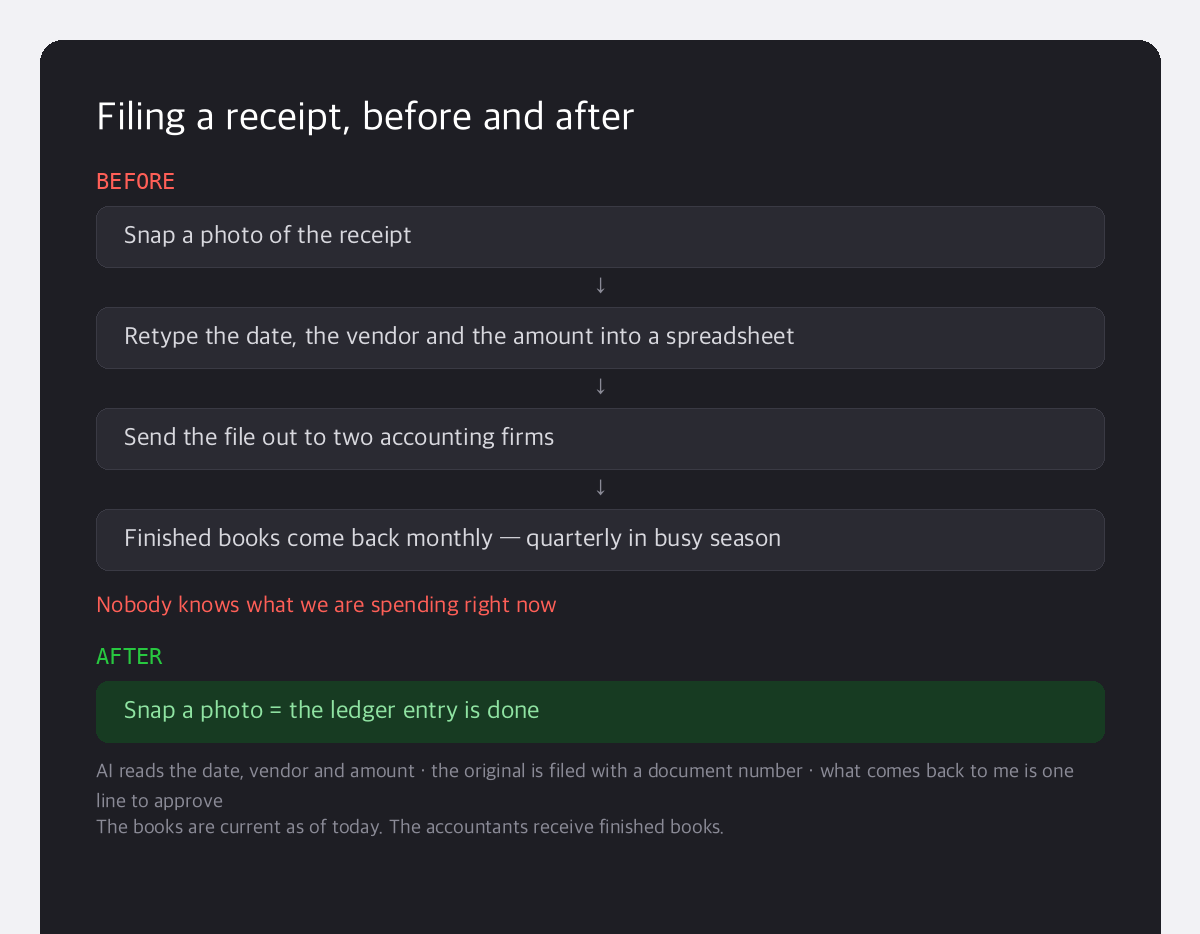
Here is how it works now. I photograph the receipt and upload it. That is the whole job.
An AI reads the date, the vendor and the amount off the image, writes the entry into the ledger, and files the original with a document number attached. What comes back to me is a single line: document number, category, amount, filed. I read it in about two seconds. Nothing else is required of me. What goes to the accounting firms is no longer a pile of raw files. It is a finished set of books.
Expense filing did not get faster. It stopped existing as a task inside the company.
Two details matter more than the tooling. First, the document number: every entry keeps a link back to the original image, so the ledger is auditable without me remembering anything. Second, the one-line confirmation. I still see every transaction. I approve; I just do not transcribe. Semi-automatic, not autonomous. I will come back to why I insist on that distinction in another post.
What changed downstream
I went looking for spreadsheet automation and the conclusion was, paradoxically, to stop opening the spreadsheet.
Because the ledger is current as of today, decisions got faster. I no longer ask what we spent last month. I look at what we are spending today, while it is still a thing I can act on. If one entity's costs are drifting, I see it in the first week, not on the twentieth of the following month, and the phone call I make about it is still useful.
The time I used to spend filing receipts now goes into reading the numbers. That trade sounds modest written down. In practice it is the difference between administering a company and running one.
So: how are you handling receipts right now? If your answer involves a person retyping numbers, that person is your ledger's clock speed.