There is one question I have carried the entire time I have been running companies. Not a strategic one. A simple one.
What is my company doing right now?
I chased that question with everything I had. I opened every file we owned. I exported by customer, by product, by region. I built pivot tables to see when revenue actually lands, which SKU really moves, which account is quietly carrying the quarter. I was constantly busy analyzing, and I was reasonably good at it.
And the uneasy feeling never went away. That bothered me more than the work did.
No matter how much I analyzed, I only ever saw the past
The reason turned out to be structural, not a failure of effort.
Every table I built was a story about something that had already finished. The moment you export data, it is history. You are analyzing a photograph. You can make a beautiful photograph (annotate it, chart it, cross-reference it), and it is still a photograph of a moment that has passed.
When AI arrived I did the obvious thing: I threw spreadsheets at it and asked for analysis. It was good at that. It was also still the same trap. Better interpretation of an export is still interpretation of an export. It was not live.
So there I was, running forward while looking backward, and calling it management.
MCP: giving the AI an employee badge
Then I came across MCP. The name sounds technical and off-putting, so let me describe it the way I explain it to other operators.
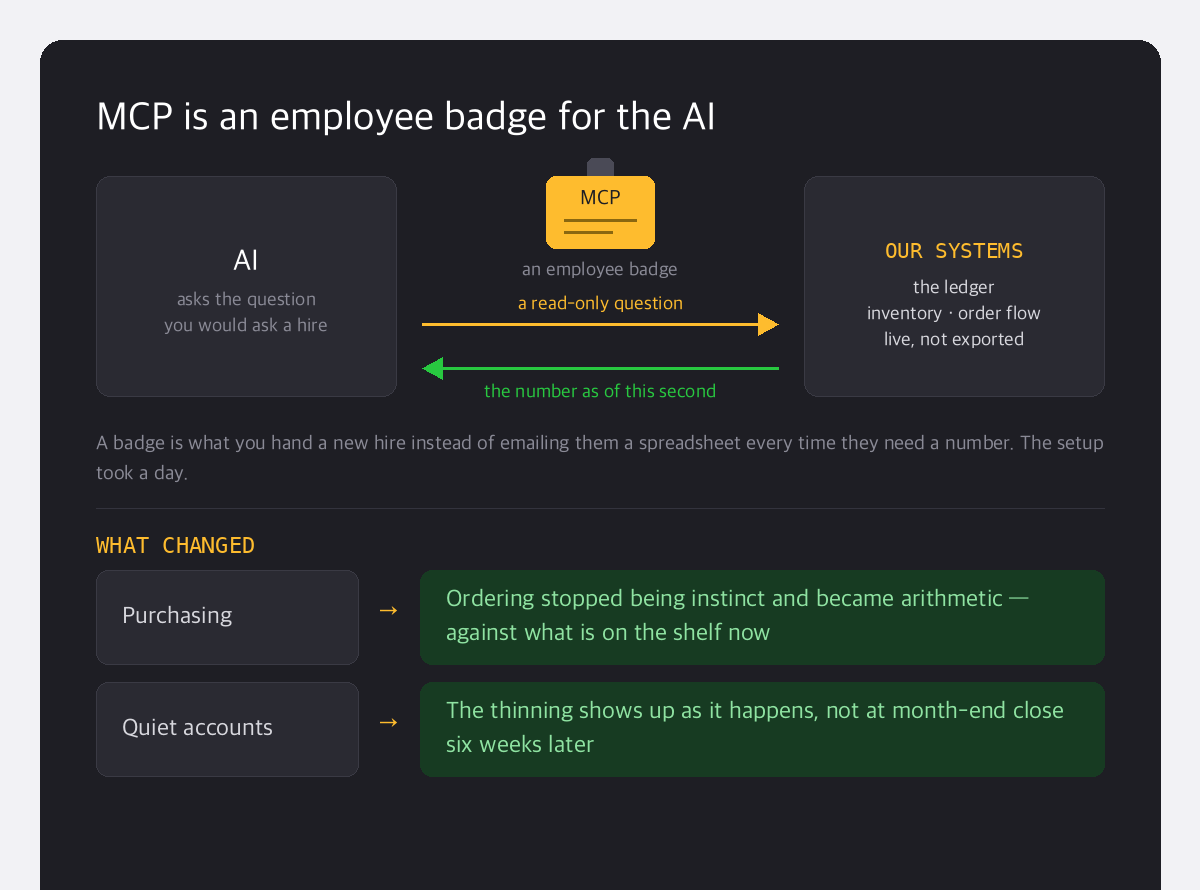
MCP is an employee badge for the AI.
Think about what a badge does for a new hire. You do not email them a spreadsheet every time they need a number. You give them credentials, and they walk into the system and look. That is the whole difference. An MCP server is a door you open into your own systems. Once it is open, the AI reads our books directly.
No export. No "let me pull that file for you." When I ask a question, the number it comes back with is the number as of that second, taken from the ledger itself.
The setup took a day. I want to be clear about that, because people assume this is a quarter-long IT project. It is not. And the setup is not the hard part anyway. The hard part (the part that stays the CEO's job and cannot be delegated) is knowing what to ask.
Two things that actually changed
I try to judge these projects by what changed in the business, not by how the demo felt. Two things changed.
Purchasing got tight. With inventory and order flow visible in real time, ordering stopped being instinct and became arithmetic. I used to place orders based on a feel for the season and a vague memory of last year. Now the decision is made against what is actually on the shelf and what is actually moving this week. Same buyer, same suppliers, much tighter.
Accounts that went quiet became visible. This is the one I did not anticipate, and it is worth more than the first.
We used to discover a lapsed customer at month-end close. Someone would look at the report and say, huh, why hasn't this account ordered lately? By then the silence was already six or eight weeks old, and a two-month silence is a different conversation than a two-week one.
Now the thinning shows up as it happens, and I pick up the phone immediately. Almost every time there is a concrete reason: a change in their staffing, a competitor's quote, a delivery problem nobody escalated. And most times, that one phone call keeps the account. The AI is not selling anything. It is noticing, earlier than my team and I were noticing, that something stopped.
From a company that analyzes the past to one that sees the present
If I have learned one thing since I started running the business this way in the spring, it is this: the real value of AI in a company is not that it writes your reports for you. It is that it can show you the present.
Reports are a summary of what already happened, and there was never a shortage of those. What was missing was a live view, and the tedious thing about a live view is that it requires giving up the comfort of the export, where you control the frame and the timing.
MCP was the beginning of that. The hours I used to spend analyzing what had happened now go into deciding what happens next. That is the whole trade, and it is a good one.
Next time: what these connected systems actually do over the course of a single day.