There is a support agent at my company that has no desk and draws no salary. When I open the inbox in the morning, the replies are already drafted. How the mail gets sorted into lanes in the first place is a subject for another post. What I want to write about here is the part that comes after the sorting: once a message is in the right lane, who actually answers it?
Sorting was solved. The replies still started from a blank screen.
Even after the classification settled, my hands never got lighter. Quote requests landed in the quote lane, purchase orders in the order lane, and the reply still began on an empty screen. Someone read the message, worked out what was missing, wrote back to the customer to ask for it, waited for the answer, and only then priced the quote and wrote the reply. Five human touches for one request. I had been calling that automation. It was closer to stacking paper neatly on a desk.
A missing field showed up days later
Orders hurt more. A purchase order would arrive with the quantity but no specification, or the specification but no delivery date. The trouble is that nothing goes wrong at that moment. You place the order, days pass, and it surfaces while the goods are being prepared: which spec was this? From there the day opens with an apology call. One empty field cost us days.
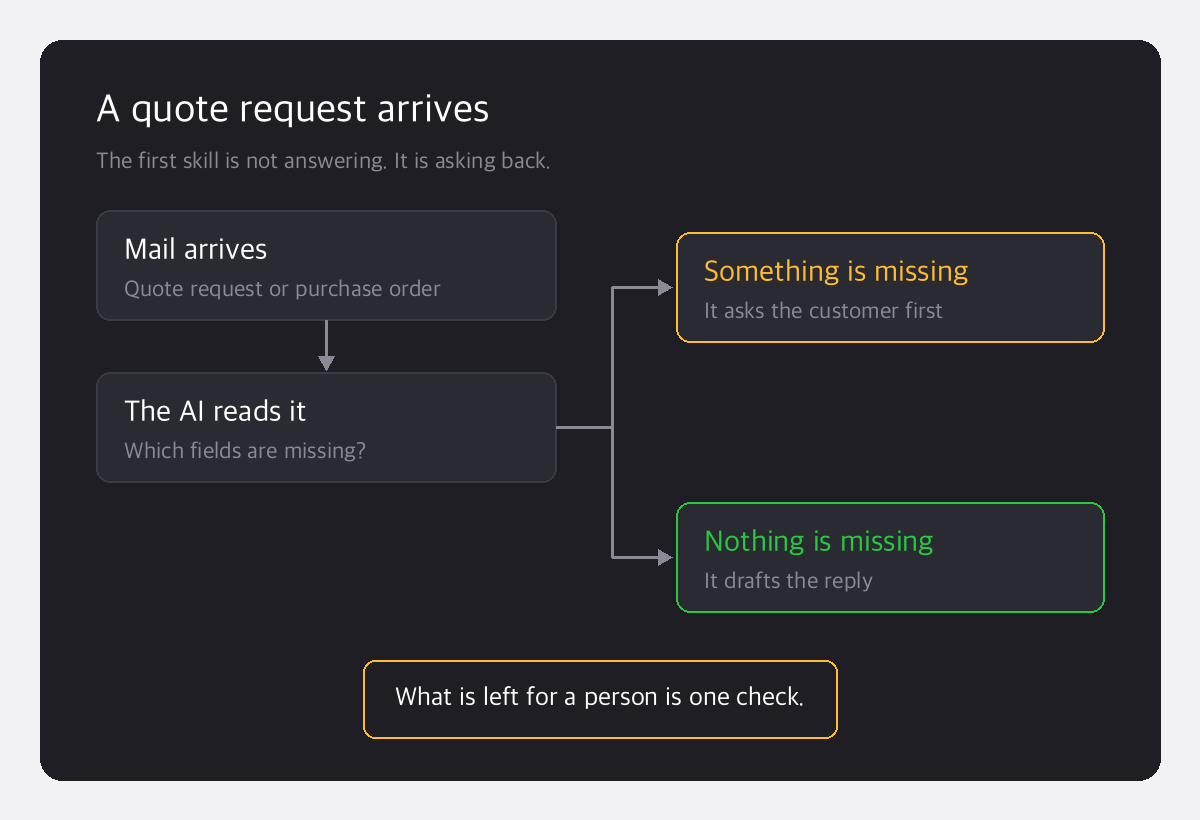
Support is not answering. It is asking back.
Once I was properly stuck I changed the question. We were not slow because we wrote poor replies. We were slow because the information needed to write one was always incomplete. A quote needs a quantity, a specification, a delivery date and a destination, and if one of those is blank there is no reply to write. So the first skill of an AI support agent is not fluency. It is noticing what is missing and asking for it first.
I taught it one reply type at a time
I started teaching the agent by message type. When a quote request comes in, answer along these lines. When a purchase order comes in, answer along those. One lane at a time, nothing clever. Now, when an enquiry lands for a particular item, the AI asks the customer for the information a quote actually needs. When a purchase order arrives with an empty field, it finds the gap and writes back to say what is missing. That is very nearly the whole of what it does. The work that used to belong to the person handling repeat quotes is handled here.
The ledger entry went from typing to clicking
The inbox was not the only thing that changed. When an order is confirmed someone has to raise an entry in the ERP: counterparty, item, quantity, unit price, typed in field by field. Those values are already sitting in the mail that went back and forth, so raising the entry is now a matter of reading it and clicking once. The place where things got retyped is gone, and the typos that used to live there went with it.
The first skill of an AI support agent is not fluency. It is noticing what is missing and asking for it first.
Here are the numbers. A quote request used to take five human touches and now takes one: of reading, asking back, waiting, pricing and writing, the only step still mine is the last check. A missing field on a purchase order used to surface days later and now surfaces the moment the mail arrives. Raising a ledger entry went from typing every field to a single click. What disappeared at my company was not a job. It was a step. The work moved from writing to deciding.