At the start, everything was easy. I typed what I wanted and it got calculated, written, built. Building an AI agent really is not the hard part. Give it an afternoon and you will have one running. What caught me was everything that came after.
Then one became two, and two became three
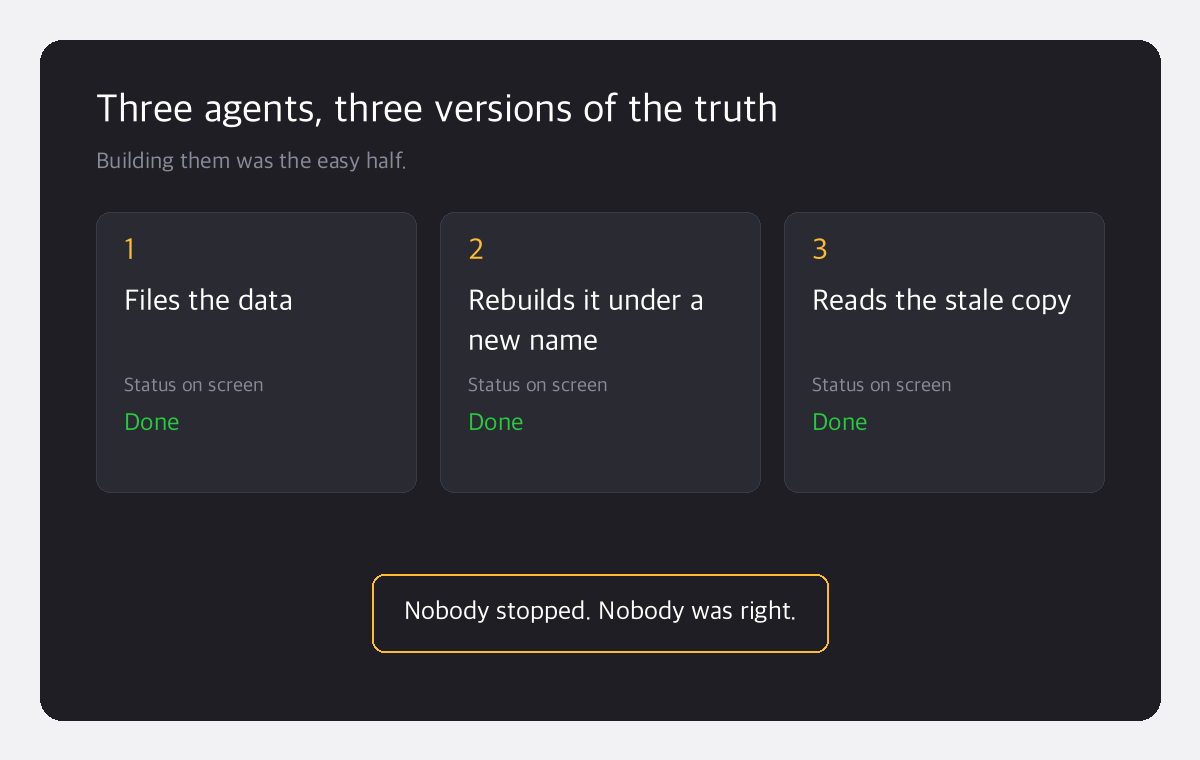
The first one was a pleasure. Then there was a second, then a third, and that is when the trouble started. I am not an engineer. I had no idea what a backend was, or where my data actually lived. So my agents began tripping over each other. The first filed a set of records. The second rebuilt the same thing under a different name. The third read the older copy and reported something that was simply not true. On screen, all three said done. Nobody stopped, and nobody was right.
The worse part is that I did not catch it that day. I found it days later, working backwards from a number that would not reconcile. A person's mistake announces itself. A machine's mistake accumulates quietly.
The question I used to ask my developers
What came to mind first was an old memory. I had asked developers, more than once, "It's built. Why doesn't it work?" I asked that with no sense of the distance between built and running. Walking that distance myself is what showed me how rude the question was. Demonstrating something takes a day. Making it produce the same result every day costs several times that.
Building is a feature problem. Running is a structural problem.
Here is the short version. Building an AI agent is simple. Getting a group of them to do their own jobs without contradicting each other asks for more than building. Building is about features. Running is about structure, and those are not the same skill.
So I shut it all down and rebuilt for a month
I closed out everything I had built and spent a month building it again from the beginning. It was less about adding features than about writing the same work thirty different ways. Somewhere past version thirty it finally landed: what a backend is and what a frontend is, how data should be separated, how a server actually runs. AI let me learn all of it fast. The real course on how to build AI agents was not a course. It was that month.
Fifty services later, I still have no spare time
I now use close to fifty services. Which ones is a subject for another post. Most of what used to be my working day is finished before lunch. Does that leave me with free time? It does not. You find new bugs while you work, you get greedy and try one more thing, and you end up merging several pieces that had been running on their own.
A person's mistake announces itself. A machine's mistake accumulates quietly.
Learning how to build an AI agent takes a day. Making it run without failure (and then serving it to someone other than yourself) is the next order of problem. Building is easy; keeping it running is the hard part.