Most of what I have written here so far has been about thinking. Who I am, what I decided not to do. Today I want to get concrete and show what the AI automation I actually use looks like. The short version: since I built it, my company keeps working while I sleep.
Most of my day was repeated conversation
Take email. We talk over email, and the talking leads to actions. In my case, that meant asking an engineer to set up a demo, or asking the sales team to check on something. One day I looked closely at those threads and realized most of them were repetition. Similar mail comes in, I make the same call, I ask the same person for the same thing. There was no reason a human had to do that every time.
Starting from the "100 agents" picture is how you get stuck
YouTube is full of stories about fifty or a hundred AI agents running a business on their own. It looks impressive. But if you copy that picture before you know what your company actually repeats, you do not get automation. You get one more thing to manage. I got stuck exactly this way at first.
Automation starts with sorting
After getting stuck, I redefined the problem. The essence of an automation program is not advanced technology. It is classification. Take what comes in through everyday conversations, everyday apps, everyday processes, sort it automatically, and define the next action for each category. That is the whole thing. Once the sorting and the actions are fixed, a machine can repeat them day and night.
Example one: email
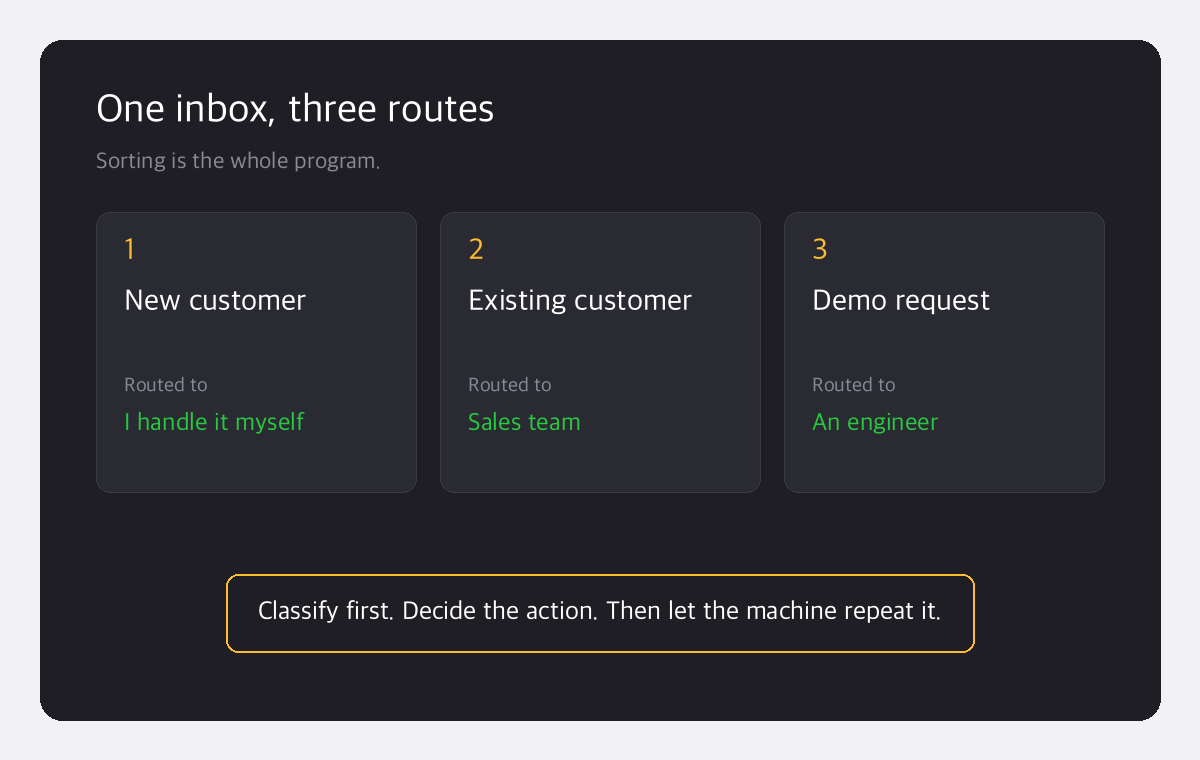
I had my incoming mail sorted three ways.
- New customers. I handle them myself.
- Existing customers. Forwarded to the sales team.
- Demo requests from new customers. Routed to an engineer.
Three rules. That alone completed my first mail automation. Mail that arrives overnight is already where it belongs by morning.
Example two: receipts
I used to sort receipts by company myself. Now I dump every receipt into one folder and AI sorts them by company. That was the entire starting point. From there it grew until it now posts into our ERP automatically, and my share of that work is effectively zero.
The order is what matters
Every company repeats different things, and the details need customizing, so I cannot write a universal manual here. But the order is the same everywhere.
- Classify. Write down what you actually repeat.
- Define. For each category, decide what action follows.
- Build. Automate them one at a time, calmly.
Get the order right, and the number of agents stops mattering.
The essence of an automation program is not advanced technology. It is classification.
What conversation repeats every day in your work? That one sorting table is the blueprint of your automation.