The question I get most often now is which AI agent someone should use. I run five companies on AI, so people assume I have a shortlist ready. I don't answer straight away, and the reason is the point of this post.
A real recommendation starts with questions
To answer properly I would have to ask first. What are you using today. What takes up most of your working day. How many people are in the company. Only after that can I say what to bolt on, because the answer genuinely differs by company. I am writing this for owners and staff at small companies. Large corporations have their own teams for this and never face the question.
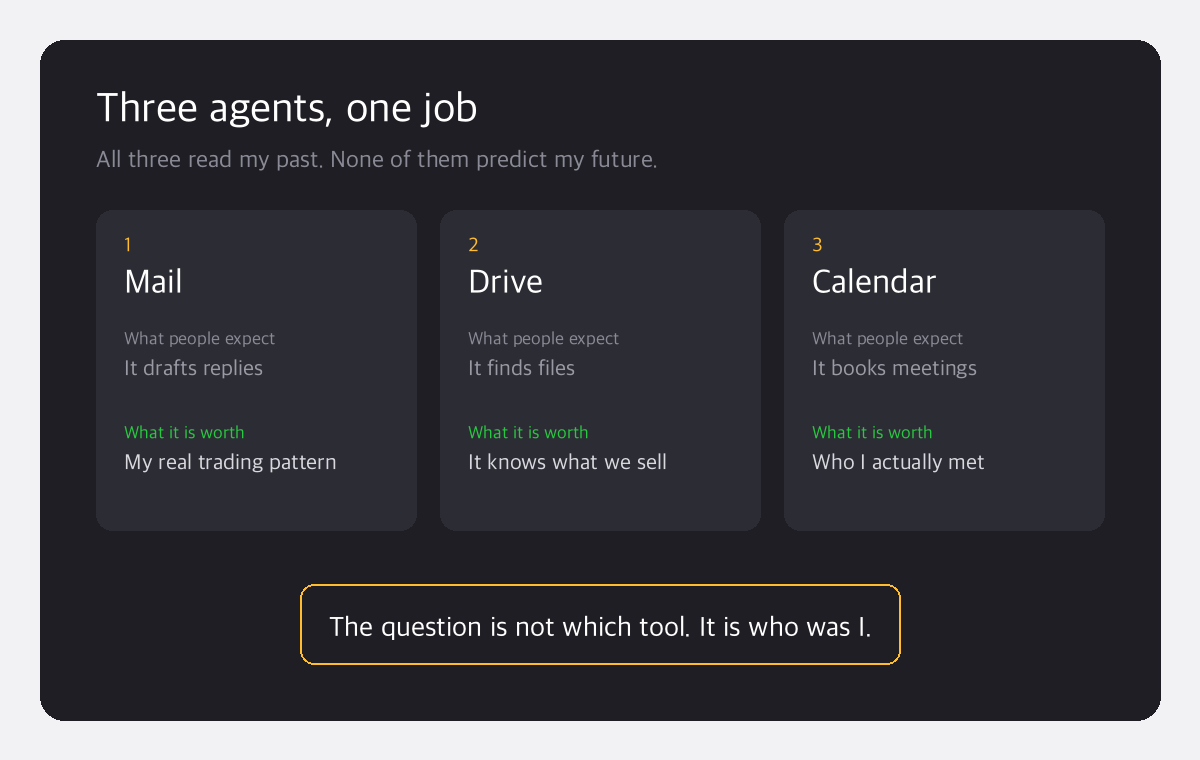
But if you held me to one, I would say mail. Not the part that drafts your replies. That is the incidental benefit. The real thing is letting the agent read your entire mail history.
Once it has, patterns you did not know about surface. Which counterparties you actually work with most. Whether the only people you are talking to lately are suppliers. Whether the emails that create revenue have been thinning out for months. That last one caught me. The pattern of my business was not in my head. It was in my mail history.
Second: give it your own material
The second thing I connect is my document store (Google Drive, in my case). The agent needs to know what products I handle, what quotes I have written, what our material actually looks like. Only then does it describe us accurately when it speaks on my behalf.
This is where AI adoption usually fails. People roll out whatever everyone else is rolling out, without knowing themselves first. The tool is good and it knows nothing about your company, so the answers it gives you are somebody else's answers.
Third: the calendar
Again, not the scheduling. The point is letting it read the calendar you already have. Who you met most over the past year, and where your hours actually went, is all sitting there. I found out that the people I believed I needed to see and the people I actually saw were two different lists.
Once it is connected, ask these four
- Who are the ten counterparties I exchanged the most mail with over the past year?
- Of those, what is the split between money coming in and money going out?
- Read my material and describe our company in three sentences.
- From last year's calendar, what are the five things I spent the most time on?
About half the answers will not match what you expected. That mismatched half is what connecting these three was worth.
It is really about knowing yourself
So the honest version of my recommendation is not a list of tools. It is a process of getting to know yourself. Mail, documents, calendar: all three are my past. People keep asking AI about the future, and I think the order is backwards. Analyse your past first, and find out what kind of person you have been and what kind of company yours has actually been.
The pattern of my business was not in my head. It was in my mail history.
Socrates said know thyself. That was the human assignment long before any of this existed. The tools changed. The assignment did not.
So — how well do you know yourself? And how well do you know your own company?