I built the thing on my own, and then I started putting it into the companies I own, one at a time. What it took to build it is a story I have already told. This one starts afterwards, not with the software, but with the people who had to sit down in front of it.
The same screen, two opposite reactions
The split showed up on day one. One person clicked through a few times and said, well, there is no work left for me to do. He was looking at a job he used to do by hand and seeing it gone. Another person said the opposite: we already do this, so why go to all this trouble? She had a way of working that functioned, and what she heard was that there was now one more screen to learn. I do not think either of them was wrong. The first one saw work disappearing. The second one saw work being added.
Every request I took made the thing heavier
So I started collecting what everyone wanted. A field here, a button there. I took each request and built it. And the more I listened, the further I drifted from what I had set out to do. Screens multiplied. So did the number of places you had to click. Something I had built to remove work was turning into a different way of doing the same work. I had not set out to become an AI company. I had set out to have less to do. For a while I genuinely did not know what to do about it.
The point was never the screen. It was the know-how.
Stuck, I went back to the goal I had written down at the start. I was not trying to build a nicer screen. I was trying to get everything my people carry in their heads into the AI, so that someone who joined next month could do the job anyway. Put that way, my own job got clear too. It was not to take down requirements. It was to teach. If you think of training your team on AI as showing them which buttons to press, you never get anywhere. It is closer to moving what a person knows across into the machine.
I said one thing to the veterans and another to the beginners
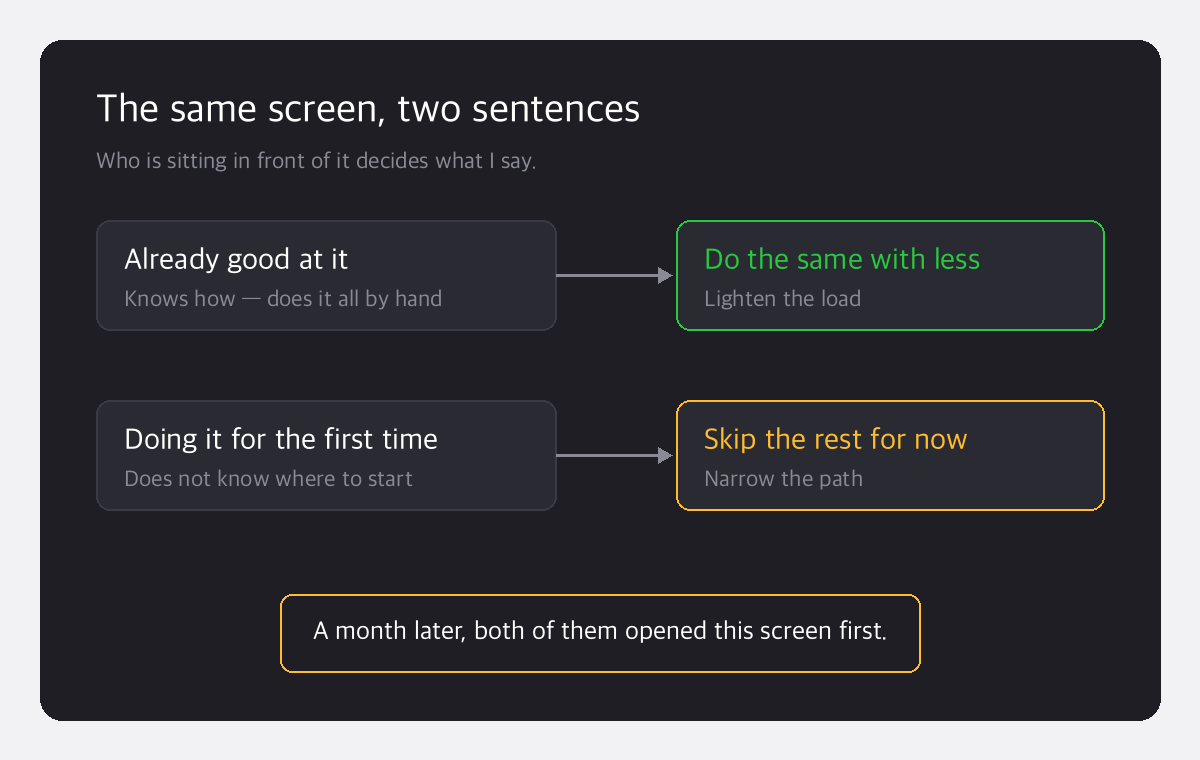
So I changed the sentence depending on who was in front of me. To the people who were already good at the job, I said: here is how to do the same thing with less effort. They were never slow because they did not know how. They were slow because they did all of it by hand. To the people doing the job for the first time, I said: do it this way, and you can skip the rest for now. What they needed was not the whole body of knowledge. It was one narrow path that produced a result today. Same screen, two sentences: lighten the load on one side, narrow the path on the other. Of everything I tried, those two sentences did the most work.
A month later they stopped opening the old software
Separately from the time it took to build, teaching took about another month. In that month I never once ordered anyone to use it. But at some point people stopped opening the software they had always used and opened mine instead. There are still rough edges, and situations I did not see coming. Even so, they tell me it is easier, and the volume of work dropped enough that their time now goes into the part that is actually about people: meeting them, persuading them, selling. If there is a day a company becomes an AI company, I do not think it is the day you buy the tool. I think it is this one.
Lighten the load for the ones who are already good. Narrow the path for the ones starting out.
Training a team on AI turned out not to be a course in how to use software. It was taking work off one group and cutting the field of view down for the other. Building the thing and getting it used are two different jobs, and I spent an extra month on the second one. I am curious how many people have built something, handed it over, and stayed with it long enough that the team started opening it on their own.